Showing posts with label Finance. Show all posts

Tuesday, January 10, 2012

Saving Money Can Be Music To Your Ears


In high school I served tables part-time at a local restaurant.  I wish I could say that I was saving for college or putting money away to secure my financial future.  In truth, the money was mostly spent on CD’s (and we’re not talking about Certificate Deposit here).  Music has always been a part of my life, so spending the cash on the latest album was natural to me.  The cost added up quickly.  Often, I could spend upwards of $40-50 in a week.

Then came iTunes.  No need to buy 14 songs on an album when you could simply have the one or two that you really liked. A quick download brought the music straight to your computer/iPod and you were ready to go. Still, if you are anything like me, you enthusiasm for music could lead you to spend upwards of $150 or more in a given year.  Now a new era has begun…

Spotify launched in the United States just a few short months ago.  It resembles an iTunes format in that you can get the songs you want, put them into playlists, and listen at will.  The biggest difference… Spotify offers free music.   That’s right free.  Like Pandora, there are some commercials that will be interjected into your playlist.  Unlike Pandora, your music is completely customizable, just like an iTunes playlist.

For a small monthly fee ($4.99 a month) you can listen to your music without commercial interruption.  While this amounts to $60 a year, it is still a fraction of the price that I would pay in a year’s time.  For $9.99 a month you can stream to your mobile devices.  Since I don’t listen to much music on my mobile devices, this is not as appealing to me for the additional cost.  However, if you do like music on your mobile device and spend more that $120 a year on music, this could be a viable option to save money.

“Wait just a minute!” my legally-minded friends may be thinking.  “How could this be free and legal?  Sounds a little Napster-esc to me.”  Let me sooth your worries with these two facts about Spotify.  First, you don’t own the music and cannot burn, share, or copy it.  Therefore, the music does not belong to you. Second, according to Spotify any artist that is featured through their service makes money from being streamed to your computer.  So you can feel good about supporting you favorite artist legally when you listen.

I’ve used the service for about five months now personally and for the organization I work for.  The library contains almost all the artists and titles that I have searched.  The quality of the streaming is as if it were an actual file playing from my computer.  It has apps and a social media component through Facebook if you are interested.  I’m a raving fan.  So sign up and check it out for yourself…  Happy listening!

www.spotify.com

Tuesday, January 3, 2012

Looking Back to Look Forward


Whether it is saving a few extra dollars or getting out of debt, many people take the New Year as an opportunity to set some financial resolutions.  Before we can look to 2012’s personal financial forecast, we have to look back at 2011.  Our last year of life is very telling when it comes to predicting where our pitfalls and opportunities are in the coming year.

If saving some cash is your resolution, take a look back at your bank statements from 2011 and ask what kept you from saving in the last 12 months.  Is there a pattern of expenses that drained your accounts?  What can you do to change that pattern?  If getting out of debt is your goal, figure out where your debt came from in 2011.  Where are the credit charges coming from?  How can you change those habits in the next 365 days?

It has been said, “Those who don’t know their history are doomed to repeat it.”  This is true not only for world history, but for our finances as well.  If you are looking for a financial road map for the New Year, you can always pull out the one you traveled in 2011.  The terrain will most like be the same, but how you navigate it can be completely different.

May 2012 be your best financial year ever!

Sunday, December 25, 2011

Merry Christmas!!

Merry Christmas!!!
We hope that you are enjoying your Christmas with Family today!  We sure are!!
Our daily, 'Navigating the rope' posts will resume January 2nd, 2012!  For this next week, take some time and enjoy being with family!  


Coming soon!  
Tips on how to make New Year's Resolutions Last, 
as well as a list of attainable New Year's Resolutions! 

Tuesday, December 20, 2011

Christmas Shopping tips from Dave Ramsey


The following post was taken from Dave Ramsey's website, offering "Real Debt Help!"  It's a great reminder as you're trying to finish up purchasing those last minute gifts!!

__________________________

We’ve all paid “stupid tax”—making costly decisions with zeros on the end. A lot of those decisions happen when we’re caught up in the emotion of the Christmas season and procrastinate a little too long.
Make this year different!
Here are the top 10 Christmas shopping mistakes and how you can act differently:
  1. Not prioritizing.
    Instead of getting stressed out with all the parties, baking and shopping, in addition to your normal daily life, set some priorities before you’re bombarded with a million requests. Think about which things are “must do” and which are “would be nice to do.” It’s all right to say no to keep yourself sane. Shopping for gifts is more fun when you’re not completely stressed out.
  2. Not using a budget.
    Before you make a gift list and head to the mall, set aside a reasonable amount of money for gifts. Make a commitment that you won’t add $20 to the fund every week just because you saw something cute that your niece would love. Get budgeting advice here.
  3. Using credit cards.
    Once you have your budget finalized, stay away from credit cards! You will still spend 12-18% more if you use plastic, and you’ll be paying it off come 2009! Doesn’t paying with cash sound more freeing than having a credit card balance looming over your head? You bet.
  4. Buying for everyone.
    Do you really need to buy gifts for every family member and friend you have? That can get overwhelming and expensive for everyone. Talk with them and work toward an agreement to draw names for gifts or donate money to a common cause.
  5. Not listening.
    Listen to the hints your loved ones drop about what they need or want this year. Maybe your Aunt Sally mentioned that she would love someone to help her in the garden, or Cousin Bob keeps losing guitar picks. A thoughtful gift like this will mean a lot.
  6. Not having a thought-out list on paper. 
    If you think you can spend time in “Christmas retail world” without getting distracted by all the shiny toys, you’re in for a big surprise! You’ll be more likely to buy impulsively if you do it that way. Write down what each person you’re buying for would like and stick to the list. Stay focused!
  7. Not shopping around.
    “Shopping around” doesn’t mean you have to spend 24 extra hours running from store to store to save 10 cents. Take a look at your gift list and do some comparative price-checking online before you head out into the retail and traffic madness. This will save you money, time and stress!
  8. Waiting until the last minute.
    Procrastination is not the most appealing gift out there. Don’t find yourself stressed out on Christmas Eve just because you didn’t invest a little bit of time to plan.
  9. Forgetting to plan for next year.
    Throughout the next year, look for outrageous sales on things your loved ones will need. If you time the sales just right and clip some coupons, you could land a major discount on something you were going to buy in a few months for a birthday or wedding gift. Remember to have a list and budget for this, too.
  10. Forgetting why we celebrate.
    If this season becomes all about shopping and gifts, you’ve missed the whole point. People—not things—matter. The miraculous birth of a baby who changed the world is what matters.

Tuesday, December 13, 2011

Keeping Track!


It’s the end of the month, and you’ve finally sat down to pay those bills that have sat quietly on your desk, waiting for you to care for them.  It’s then, that you work on writing the check for the $200+ electric bill, and the should-never-have-been-that-high cell phone bill, when you place your head in your hands wondering where all of your money went.  You know that when you started the month, you had plenty of money to cover the standard bills that would come your way, along with taking care of a few extras along the way, but now that D-Day has arrived, it seems that the money has vanished.  Unfortunately you have just found yourself buried in a case of the “missing money!”

One of the best tips that we were ever given, upon being married, was to keep track of all of our money.  In an effort to manage our family finances with expertise (and knowing that I had no idea what I was doing!) I found myself at our local library in the first month we were married, taking a class on how to manage your finances.  Honestly, I don’t remember much of what was said in that hour-long class, but the one thing I do remember is that the lady kept emphasizing the importance of keeping-track of what you spend.  She talked about the importance of developing a budget, but being sure to base your figures on actual expenses, rather than estimated costs. 

So we did just that.  Every single time that debit card was swiped, or cash left our hand, we asked for a receipt.  Every…single…time, for an entire month!  You would have thought it was snowing in our tiny apartment, because of all of the receipts we had floating around.  BUT, at the end of the month, I sat down and organized all of the receipts based on the type of expense they were.  Groceries.  Eating Out.  School supplies, etc.  Once I organized all of the receipts, I added up their totals, and put those totals into a spreadsheet I created on our computer, listed by category.  When Steve got home, we sat down and looked through all of our expenses, and developed a budget based on what had spent. 

For example, if we saw that we spent $200 on eating out, we pulled out a calendar and looked at all of the times throughout the next month that we would be eating out.  Then, we developed a budget that we thought we could stick to.   (For instance, we gave Steve $12.50 a week to spend on his lunches.  That meant that if he decided to drink a coke and eat sushi one day, totaling $12.00, then he would starve the rest of the week, or eat Ramen Noodles purchased with his remaining 50 cents!)
One of our goals was to save enough money to put a down payment on our first house, which meant that we couldn’t spend every dime that we brought home from our jobs.  So, we had to cut in some of our other spending areas, and sometimes get creative in how we functioned day-to-day.

So, how does this translate to your own family budget?  I’d encourage you to do the same.  Developing your own family budget, based on ACTUAL expenses, and not estimated costs.  That means that you too, need to have a flurry of receipts in your home, collecting over the course of a month (or two!), so that you can see how much you truly spend on various things.  Based on the figures you’ll compile, you can develop a budget that you’re able to stick to, and hopefully accomplish those financial goals you’re striving for!
I believe in you!  Good luck!

Tuesday, December 6, 2011

Money-Saving Book Review


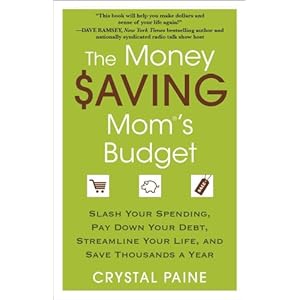
Book Review: The Money Saving Mom’s Budget

One of my favorite websites, in regards to saving money with a Faith Perspective, is moneysavingmom.com.  Crystal Paine has done a phenomenal job at finding ways to live a full life frugally, and she does it all while maintaining a kingdom-focus.  Recently, we received her book and were asked to read it and give an honest review of it to you!  Knowing the impact that she has already made on our own personal finances, we were happy to comply, and as soon as the book arrived I quickly began reading!

After finishing the book I fully believe that this is one of the best, most applicable, money-saving books for moms that I’ve seen in a long while!  Crystal walks through NUMEROUS ways to save money ranging from how to develop a budget that works, as well as ways to coupon, and even reduce unwanted clutter in your home.  The book covers so much more than just saving money – she really focuses on improving your life overall!  This book is a quick, and excellent read!

Perhaps my favorite section of the entire book was her chapter on how to “Go out on the town without going broke.” Over and over she gives tips and tricks to saving money without ruining your life!  She provides websites to find places that kids can eat free, and discusses the importance of refusing to pay retail for things in the store.  “There are so many ways to enjoy life,” she says, “ at a discount!  When you commit to never paying retail, it opens up a world of creative ideas and possibilities.” 

The book is jam-packed with websites to use in planning your spending, worksheets she’s created to help get a handle on your own spending, and stories from other individuals who have made cost-cutting work for them!  If you’re looking for a hands-on strategic book to help you get your spending in order, this is what you’re looking for!  I loved it!

The book will not be released until January 10, 2012, however, you can find more information about pre-ordering the book by clicking  here


Tuesday, November 29, 2011

Don't pay for more than you need!


Have you ever watched one of those TV infomercials that seem incredibly too-good-to-be-true!  You think to yourself, “Wow!  If I just have that (fill in the blank) life will be so much easier.”  Then, the more you watch, the more that they offer!  “But wait!  If you order in the next 30 minutes we’ll send you not just one “Sham wow”, but two!”  You know what I’m talking about!  Keep watching the commercial and they may finish the ad by offering you 4 of the item as well as 2 other completely different items altogether!  What a deal!  (Please notice my sarcastic undertones…)

Recently, as we were combing through our own monthly budget, and trying to find places to save costs, we determined to contact our “variable cost providers” and see what else they could do for us.  You see, we realized that we were paying for nearly 700 minutes a month MORE on our cell phones than what we use on a regular basis.  There wasn’t a lower plan advertised online, but hey!  It’s a phone call and the worst that they could say is “no.”  I called and much to my surprise, they found a cell phone plan that provided us with all of the “perks” and benefits that we needed and still saved us $20 a month from what we had been paying!!  As you can imagine, we were thrilled!

Well, it didn’t stop there!  We decided that there are a BUNCH of channels on our TV that we rarely ever watch, so we gave our TV Company a call asking if they had any plans available that would match what we needed.  (We didn’t want to extend or re-up a contract at all, but wanted to drop our bottom-line bill amount.)  Much to my surprise, they DID have a plan available which offered us all of the main channels and many of the fun kids channels that Caleb likes to watch when I let him (Sprout, Disney, etc!) and it was another $20 less PER MONTH!  That means, between our TV and Cell Phones alone we saved $40 PER MONTH ($480 per year) with just a simple phone call.    Neither adjustment really changes our normal life at all, but we can do a lot with an additional $40 every month!  (Not to mention an extra $40 this month to spend on Christmas gifts – YAY!)

Here’s the point.  It’s easy to get roped into the biggest and the best products, thinking that we need all of the bells and whistles that are offered.  Many times, though, we just don’t end up using those ‘bells’ as originally thought.  Perhaps its time to take a look at your cell phone bill and see how many minutes you’re ACTUALLY using on average every month, compared to how many you’re paying for.  Just because “unlimited” sounds great, doesn’t mean it’s necessary!  Who knows!  Maybe you just want a landline phone to use for emergency situations, but you’re still paying $30+ for that service!  Why not check out magicjack.com and do away with your monthly phone service altogether!  (Disclaimer: I haven’t ever used magic jack myself, but have heard rave reviews.)

As Christmas gets closer, and we’re all trying to make “miracles” happen with our gift-giving, why not look at other areas of your spending first to see where you can free up some money without making any sacrifices.  You’ll be glad that you did!

Tuesday, November 22, 2011

Black Friday Tips and Tricks


Thanksgiving is just days away and for many of you, that means that the anticipated “Black Friday” is almost here!  There are phenomenal deals to be had, and wild memories to share, but this day can also create a lot of additional stress and unnecessary spending if you’re not careful.  Here are just a few tips for you, as you head into this popular spending day.

1. Plan ahead – Stores are full of incredible deals, and therefore the temptation is GREAT to walk into the store planning to buy 1 TV and walk out with 4 IPOD’S, and Nook Color, 2 TV’s and a few DVD’s!  Just like on any day of the year, stores are smart and will place catchy signs and “incredible deals” right near where you’ll be (check-out line, ends of the aisles, etc) with the hopes that you’ll see it and realize that the “deal is too good to be true!”  Your best bet is to walk into the store with a plan already in mind, and not become distracted or enticed by the stores schemes to get you to spend your money.  Whether you want to start planning today, by visiting sites online that list the ads that will be in Thursday’s paper (blackfriday.com), or you spend an hour going through the ads on Thursday carefully planning out your shopping trip(s), it will help you tremendously come Friday morning!  Then, once you’re in the store stay in charge of your spending and stay focused!

2.  Set your budget, and stick to it!  -- Perhaps the best idea, before you ever open up a single sales ad, is to create your “Christmas shopping list” and include the prices that you honestly can afford to pay for those items.  Once you’ve got your list together, then go through the ads, and if the price is more than you want to pay, then pass on it.  It’s absolutely NOT worth going into debt in order to buy the latest Blu-Ray player or Amazon Fire that is on a deep “Black Friday Clearance!”

3. Shop Online – One of the best strategies we have used over the years, is to do much of our Christmas shopping online!  I’ve been amazed at the deals we’ve been able to score without having to fight the crowds at Best Buy or Target, or even wake up super early Friday morning!  Keep the end in mind and remember that although the deals may not be what you’re looking for on Friday, they may be even better if you just wait and look at their website Monday morning!

4.  Don’t forget the drug stores – I know this sounds ridiculous to most of you, because when you think Black Friday, most of you think Best Buy, Walmart, or another “Super store!”  I’m here to tell you that drug stores offer some killer deals if you’re willing to work a little bit for them!  Printing off a coupon online before you head out the door, or clutching a ”Free Money“ coupon that prints after you buy the item for use at another time, can save you big bucks in the long run!  Items we’ve scored at drug stores include vacuums, digital picture frames, and even digital camera’s, all for LESS than $5 each!!  (Most of them were free!)  If you’re looking for some ways to save money at drug stores, go ahead and scout out some of the coupon websites we’ve mentioned to you before!  They’ll map out your purchases for you, and even do the math, leaving the bottom line figure for you to decide if you want the item or not!

5. Most importantly…. have fun!  -- Christmas is meant for memories to be made, families to enjoy time together, and the birth of Jesus to be celebrated!  Don’t let crazy lines, stellar deals, or pushy people ruin the start of this magical season!  Keep your attitude in check (even if your day starts at 2AM), and enter the most “wonderful time of the year” with a happy heart!!  You’ll be glad you did!

Tuesday, November 15, 2011

It Was Just $2


Beth and I had been married less than a year when it happened.  I was making a purchase at the bookstore on campus where I was attending school.  The credit card system was down in the store, which meant they could not swipe my debit card.  The books I wanted to buy were important, but not necessarily an urgent need for that day.  However, I was already there and had the books in hand.  The cashier told me there was an ATM just around the corner I could use.  I left the books with him at the counter and went in search of some cash.

When I found the ATM I noticed it was from different bank than we used.  I realized there would be a charge, but I reasoned that the charge would be minimal and would save me time in the long run.  My card was inserted, the cash spit out, and I returned to the bookstore to make my purchase.  After running a few more errands around campus, I came home to our first apartment.

Like normal, I entered in the door and found my new wife welcoming me with a smile.  We talked about our days and I got around to showing her the books I had bought.  Then I recounted the crazy story about the credit card system being down at the bookstore.

Then she asked, “So how did you get the books?”

“There was an ATM around the corner.”

She inquired further.  “Was it a Wachovia ATM?”

“No.  But it was just a $2 charge.”

The mood in the apartment changed quickly.  She was frustrated and I could tell.  I asked why it was such a big deal for me to use the ATM.  After all, it was just $2!

That was when my financially savvy wife, gently showed me of a pattern she saw emerging.  In the early months of our marriage, “it was just $___” had become a common catch phrase of mine.

“I bought this candy bar.  It was just a dollar.”

“Yeah, I parked on the street instead of using the parking lot.  But the meter was just $3.”

“I forgot to turn in those library books, but the late fees were just $1.50.”

On and on it went.  Over the course of a week I may have said it five or six times.  The average of my “it was just $ ___” was amounting to about $10 a week.  If the pattern continued without getting worse, it would have amounted to around $500 in that first year.  We were both working at quick-service restaurants (aka fast-food) and could not afford that kind of annual expense.  She got my attention and I resolved to do better.

The occasional $1 or $2 expense is not normally what sinks a family budget.  When these kinds of small expenses add up over the course of several months or a year, they can put pressure on your income.  If you are looking for a place to cut expenses to make your budget go farther, consider what unnecessary, small expenses you are spending each week.  It may just be $2, but the sum of $2 over the course of time can make a real difference in your budget.

Tuesday, November 8, 2011

If Only I Had More...


The billboard brightly proclaimed $300+ Million for the Lottery Jackpot.  I passed by the same billboard on the interstate everyday for a week.  While our family doesn’t play the lottery, it still got me thinking. 

“What would I do with that kind of money?  Certainly I would be charitable with some, pay off our mortgage, buy some things we would otherwise not have…” 

All week long, my mind continued to stack up the possibilities almost as quickly as the traffic piled up around me at rush hour on I-264.  Soon enough, the exit ramp would come and as I left the interstate I also left the thoughts of being a millionaire.  After all, there were real expenses and income to balance. 

“How are we going to possibly pay for our children’s education in the future?  Where are we going to get the money for a new car in a couple of years when we need one? I may not be a millionaire, but if I only had more money…”

This is the trap I find myself in many times.  I think about the expenses we have, the family budget we have created, and my temptation is to desire more money.  But more money really isn’t the issue.  You may have read the articles about lottery winners who squander their fortunes in a matter of years or even months.  Other men and women rise to fame for a season and make a lot of money very quickly, only to return to humble living due to poor financial decisions within the span of decade.  More money is no guarantee of a better financial position.

Most often, the issue for the American household is not that we need more money.  There are some cases in which a person has lost a job, a tragic injury occurs, or some other catastrophic event happens where more money is actually necessary.  However, for the most part, more money is not the answer we should be seeking.  Instead, making a better use of the income that we have through prioritizing financial needs is a better solution.

When you are on a steady income, you should treat money like time.  There is a limited amount of time in a day so you better use the minutes you have wisely.  With our income, there is a limited amount of dollars so we need to think of the best way to spend or save them. 

So how do you prioritize your spending?  There are a number of financial gurus who have answered this question.  Our family has taken advice from men like Dave Ramsey who provide solid principles for financial priorities.  There are other men of integrity who give wise counsel about specific expenses.  Here is one way to rank a few general categories when it comes to expenses…

  1.      Need to Live – The most basic of needs (housing, groceries, tithing, etc.)
  2.      Debt Retirement – The faster you get rid of debt the more income you will free up in the future and the less interest you will pay.  Put something toward it each month.
  3.      Future Panning – Saving ensures your future. Make sure that you are forecasting a reasonable amount needed for an emergency and your later years.
  4.       Wants – Everything else.

When we choose to take care of top financial priorities first, we relieve the anxiety that comes with spending unnecessarily and coming up short in the end.  Know where your money is going and make sure that it is flowing toward your top needs first and foremost.  You may not be able to get more money, but you can certainly control the direction of the income you generate.

Tuesday, November 1, 2011

Three Secrets To Getting The Deal


In early 2009, I was in a car accident while driving one of our family’s vehicles.  Thankfully, I was okay but our car was not.   The Dodge Stratus my wife owned since before we were married was totaled.  The car was from the 2000 model year, which meant that the insurance settlement was far short of the amount of money we needed to buy another reliable vehicle.  We were considering beginning to have kids, so we knew we needed a family friendly car for the future.  We didn’t have a lot of options so we started looking for a great deal….

The first secret we discovered in looking for a great deal was Deciding On Necessary Preferences.  We knew we needed a family vehicle from a reliable brand.  We wanted lower mileage, a strong safety rating, and clean interior.  These were our essential preferences.  Beyond that - everything else was secondary.  Color, model, interior, stereo were not as important as the BIG preferences.  This was a little difficult for me, but parting with some of my personal preferences so that we could get the major things was an essential step to getting the deal. 

After we determined our necessary preferences we started pouring over the newspaper, Internet, and any other sources we could find to get the car we needed.  We quickly learned the second secret: Patience.  There were a number of times that we saw a car that fit our preferences, but not our budget.  We thought about giving up, biting the bullet and going into debt to get a car.  However, we knew it would be hard to assume the financial responsibility.  Therefore, we had to be patient.  Since we needed two cars to function between jobs, we borrowed a car from a friend for a period of time to make things work.  It took us weeks of calling, visiting, and negotiating to finally get the deal that we needed.

Finally, after spending hours upon hours searching we found a deal.  There was an SUV we had our eye on which fit our necessary preferences, but always seemed to be priced too high for our budget when we factored in total mileage.  However, there was a dealership in our area advertising it for $5,000 less than we had seen it anywhere else.  We jumped into our remaining car and hoped the car would still be there when we arrived. 

The dealership was better described as a used car lot.  A guy named Tony (which he pronounced as “Tone-AAA”) came out to greet us.  When we showed him the print out of the vehicle he guided us to the car.  It beat our expectations.  We test-drove it and it felt right.  Then we inquired about the price listed online.  Tony quickly disappeared into a back office and brought out his manager, Schlambo.  Schlambo (or Schlammy for short) explained that it was mispriced online, but he would cut off $500 for our trouble if we still wanted the car.  This was still out of our price range.

This is the moment that we discovered the final secret to the getting the deal: We Walked Away.  We expressed how much we liked the car.  We told him we would be happy to buy it at the advertised price.  However, if it was going to be thousands of dollars more than we expected, we couldn’t do it.  So, we walked out the door.  We had done this before.  Sometimes the dealer would call and make another offer.  Most of the time we just had to keep looking.  On this particular day, as we drove home we didn’t expect to hear anything.  However, before we pulled into our driveway, we got the call we were looking for.  Schlambo explained that times were tough and he was under the gun to sell… He would give me the care for the price originally advertised online.  We turned around, make sure the Vehicle History Report checked out, and signed for the car.

Necessary Preferences guided our process.  Patience kept us from making a foolish decision.  Willingness to Walk Away gave us the negotiating edge we needed.  These three secrets got us into the vehicle I drive today at a price that we never imagined possible.  When you are making a large purchase at a negotiable price keep these things in mind.  It could be the difference between the price you want and the price you pay.

Tuesday, October 25, 2011

He’s making a list…


He’s making a list.  He’s checking it twice!”  Surely you’ve heard the catchy tune about old St. Nick checking his list of presents for little boys and girls!  As I walked through the mall this past weekend, I was amazed at all of the Christmas décor already up!   We even purchased one of our Christmas gifts for family over the weekend, and upon doing so began the spiral into embracing the “Most Wonderful Time of the Year!”   This morning, I couldn’t help but chuckle when I thought of the financial truth Santa Clause teaches us through his sweet little song.

About a month ago, my husband surprised me by taking care of all of the details ahead of time, and whisking me away for a surprise overnight retreat in Atlanta to celebrate our 5th wedding anniversary!  He had secured tickets to the Broadway Musical, “Wicked” which was conveniently playing at the Fox Theater, made reservations for an incredible restaurant for us to eat dinner at, and reserved us a room in a lovely hotel in downtown Atlanta!  5 years later…he’s still just as much of a romantic as ever!

The following week, I was at home balancing our checkbook, and noticed a charge on our credit card that was incorrect.  The hotel that we stayed at, charged us several different times, and because my husband cashed in our credit card points to pay for the room, I knew the charges were incorrect!  We called the hotel letting them know of the mistake, and after several days of watching the charge sit on our statement without movement (or a refund being credited!) I wrote a letter to the C.E.O.  Within hours I received an email back, asking for my phone number so that the hotel manager could contact me and remedy this terrible error.  After a brief conversation with the hotel manager all incorrect charges were refunded, and a certificate for a free-nights-stay was mailed out to us for use sometime in the future!  The charge was far from intentional in the first place, but this hotel went above and beyond to ensure our own satisfaction with their company and this particular hotel.  (To which we were most grateful, of course!)

Why do I share this story with you, you may ask?  Simple.  I share the story to remind you of the importance of balancing your checkbooks and checking your credit card statements.  Although this charge was incorrect, unless I would have noticed it and brought it to their attention, the hotel would have never refunded the charges. 

In our wonderful electronic-age, banks and other financial companies make it EASY to miss these kinds of errors.   We just get going and going, paying bills, buying groceries and spending away without realizing exactly where our money goes, and double checking to be sure that the correct charges have been taken out of our accounts.  We let the “automatic system” do it’s magic and errors are made by accident.  As the holiday season approaches, and swiping that “magic card” becomes more and more often, be sure you’re clutching those receipts and double-checking the charges on your statements when you get home.  No one is perfect and so mistakes are likely to be made.  I challenge you not to allow these mistakes to go unchecked in your accounts, however.  It’s time to start not only making your list, but “checking it twice.”  

Tuesday, October 18, 2011

GUEST POST: Riding the Stock Market Roller Coaster


Guest post written by Dr. Jason Landry
Jason is a phenomenal Emergency Medicine Doctor who resides in Jacksonville, FL.  Even more astounding, however, is his incredible knowledge regarding the ever-changing stock market and overall financial success!  With the wavering situation we are finding ourselves in economically, I asked Jason to give his insight and wisdom on how to handle it, and what to do!  I'm sure you'll enjoy his hands-on strategies as much as I have!


Let me start by saying that I do not have a degree in Business, nor am I employed by any Trust Funds, Banks, or even the little talking baby you see on TV who has become a day-trader.  I am just like everybody else who wants to know that if I put money away for retirement, it will be ready for me to use one day.  For decades, the most accepted way to do this was by systematically putting money into a Roth, 401k, or other equivalent plan and just watching it grow like magic.
However, over the last few years, it has become increasingly difficult to justify putting money into the market, only to see your account shrink and shrivel.  Sometimes it can even make me a bit angry and frustrated.  I feel like I could do better by just burying the money in my backyard or just setting up a simple savings account.  That way, I know that, at least, my money is growing a little.  Every time I start thinking this way, however, I am reminded of some very simple principles.  Maybe they will help you find the courage to deposit that next check into the retirement fund, even when the market seems to just fizzle it away.
1.     DOLLAR-COST AVERAGING: This is the most important principle.  It means that you put a fixed amount of money into your account at fixed time intervals, regardless of how the market is doing.  In the end you will make money, even if the market ends up at the exact same point as where it started.  For example, let’s assume you  put in $100 every month for 30 years (360 months).  If you buried that in your backyard, it would be worth $36000 when you dug it up 30 years later.  If you put it in a savings account (right now with an interest rate of 0.1%), it would be worth a bit better at $36,647.19.  However, let’s assume that you put it in the market.  And, just to make the math easy, let’s assume 1 share is worth $100.  Over the 30 years, it stays at $100/share 50% of the time (including the ending price).  But, it also is valued at $50/share 25% of the time and $150/share 25% of the time.  In 30 years, if you were diligent, you would own 420 shares, or $42,000.  That’s 14.6% better than you would have done by putting the money in a savings account!
2.     THE POWER OF TIME: If you look back at the last few years, the market looks pitiful.  All it does is go down!  But if you graph out the value of the Dow, for example, over the last 20-30 years, a much different (and more promising) trend strikes you.  Just in the 1970’s, the Dow was valued around 1000.  Now it’s around 11000!  Over time, the markets grow and people make money….if they can stomach the “Down Years”.
3.     Inflation: One big problem with burying your money out in the yard, or even placing it in a savings account, is that the dollar becomes increasingly less valuable over time.  This is called “Inflation”.  If you ask your grandma, I’m sure she will talk your ear off about how she used to be able to buy a hamburger for a nickel, for example.  Good luck finding that burger now!  If you bury $100 outside, it’s not going to be worth nearly $100 in 30 years.  You need to find a way to make it grow faster than the rate of inflation.  Time and time again, the only method that has proven to beat inflation is the market.  If you like hamburgers as much as me (just ask my wife), you’ve got to find a way to save up so you can afford them in 30 years.

      Again, I’m not a financial planner, nor did I stay at a Holiday Inn Express last night.  I just want to be a good steward of the money God blesses me with.  I know this stuff is not simple in the least.  That’s why you really ought to get in touch with a Certified Financial Planner who can figure out what is the wisest plan for you specifically.  Speaking from personal experience, they also make really good therapists when you start stressing out about this crazy Stock Market Roller Coaster.

Find more information about Dr. Jason Landry by clicking HERE.

Tuesday, October 11, 2011

10% Off for A 7 Year Headache


As a sophomore in college I was invited to staff a conference in North Carolina with a few friends.  Admittedly, part of the reason I accepted the invitation was because a stunningly beautiful girl named Beth was going to be on the trip.  This meant that I needed to look good for several days in a row at the conference.  My wardrobe of college tee-shirts and hoodies was not going to cut it. 

A couple of weeks before the trip I went to an open-air mall in South Florida to do a little shopping.  At one store I snatched up a jacket, a pair of pants, and a sweater.  The total price tag was more than a $100.  This was more than I was prepared to spend.  I started to hang the items back on the rack when I noticed a sign above the register that read:

“Sign Up for Our Store Credit Card Today and Receive A Discount on Your Purchase.”

Perfect!  Problem solved!  If I signed up for the credit card I should have just enough cash to make the purchase.  So I filled out the credit card form and surprisingly I was instantly approved.  That is when the manager told me that I could put my total purchase on the new card that day and still receive 10% off. 

“What’s not to like,” I reasoned.  More cash in my pocket meant more cash on the trip.  I could just pay off the card when I returned from the conference and get 10% off!  I charged the clothes, got the discount, and proudly exited the store with my new threads.  That was in 2004.

Several months went by and I never received a bill from the credit card company.   I forgot about making the purchase.  Then I received a call one day letting me know that I had some out-standing debt with a credit card company.  Apparently, I had put down my parents address instead of my own.  When they received notifications in the mail, I’m sure they saw it as junk mail from the clothing company and dismissed them.  As soon as I learned about the delinquency, I paid off the debt, paid the late fees, and cancelled the card.

Fast-forward four years to 2008.  The stunningly beautiful girl I went to the conference with was now my stunningly beautiful wife.  I had just accepted my first job and we were on the verge of buying a house.  That is when I learned from our loan officer that there were some blemishes on my credit.  The greatest issue… my retail store credit card.  Fortunately, we were able to prove through some other means that we were credible people to loan to and were able to buy the house.

It is now 2011.  This year, the negative blot on my credit report caused by my mismanagement of the retail credit card will finally roll off my credit report… 7 years after the incident.  The issue came up when buying a house, getting insured, buying a used car, and has negatively impacted my credit score for years.  All of that to save 10% on a clothing purchase in 2004. 

As we approach the holiday season, signs will abound in retail stores boasting a percentage off your purchase for filling out a credit card application.  Credit cards offers will become enticing when you consider the potential to “buy now, pay later”.  Before you sign your name to those kinds of applications that make such nice sounding promises, make sure you count the cost.  Late fees are expensive.  Spur of the moment credit card applications are easy to forget (especially if you fill out a number of them in the same time span).  Negative credit information stays with you for at least 7 years.  Is 10% off really worth the risk?